Installing solar systems at home is a very attractive option due to its benefits in Pakistan. The advantages are not limited to gaining independence in power generation, but also the homeowners can save money through the legally adaptive process of net metering in Pakistan. However, in February 2026, the regulatory body revised the policy and introduced the concept of net billing. The following article will share all elements of this policy, what you must know, and how this will impact savings and solar implementations for homeowners specifically. Let’s start.
What is Solar Power Net Metering?
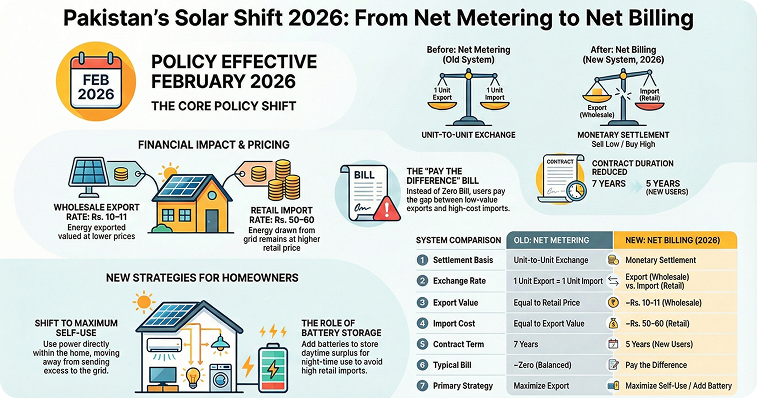
Net metering is a billing mechanism allowing solar owners to sell excess electricity to the national grid. In Pakistan, net metering was regulated under the Net Metering Regulations 2015, which carried out identical rates for importing and exporting electricity.
Furthermore, homeowners with installed solar systems have the advantages of being power independent, remaining capable of earning through excess power production, and enjoying the elevated value of their physical asset—their home. Earlier, net metering was regulated under the Net Metering Regulations 2015. However, the national power body introduced the NEPRA Prosumer Regulation 2026. This regulation replaces net metering with net billing. Moreover, it regulates solar, wind, and biogas power systems.
What is Net Billing in Pakistan?
Net billing is a concept now applicable to new solar consumers who enter into a new contract with the relevant DISCO. However, over time, existing consumers will also be subject to this contract.
Variations Between the Policies
The new policy of net billing allows us to trade excess units at certain rates, which are different. On the other hand, in net metering, the rates of importing and exporting power units were the same. Earlier, we could send back the excess units’ production to the national grid. As a result, the bill would be zero.
Take this example: if you use 100 units at night and export 100 units during the day, the bill would be zero. Now, new users will import units from the national grid at different tariffs, and the export rate will be roughly around Rs. 10–Rs. 11. The difference in balance will be reflected in a monthly bill.
Also, the return on investment (ROI) and payback period will be affected.
Impact on ROI and Payback
The new policy will extend the time for return on investment (ROI). Earlier, the payback time for on-grid systems was 2–3 years. Now the same period is extended to 4–5 years.
How to Maximize Your Benefit?
Because of these changes, the most beneficial way to use solar systems in Pakistan is to adapt to hybrid solar systems.
These systems not only allow you to maximize your reliance on solar through grid-tied and off-grid power availability, but they also allow homeowners to trade excessively generated electric power.
This means that by mostly relying on a hybrid solar system, you will be able to consume the units generated by your home solar system in Pakistan. This will lead to lower power expenses. In addition, when your solar system generates more electricity than you need, you can trade it with the national grid. It will balance your national power consumption.
Also, if you are a homeowner with an already installed solar system and you are in contract regarding net metering, your contract shall remain intact. However, if you are entering into such a contract after February 2026, you will get the new implementations effective immediately.
What are the Potential Impacts of Net Billing Regulation 2026?
The adaptation of net billing is gradual. However, the focal point is also to consider who will pay for the grid. The impact on the grid is also expanded to non-solar power consumers. Moreover, how does this shift push the households in the country? High tariffs and frequent power cuts are the primary reasons homeowners are adapting towards solar.
Furthermore, how well hybrid systems align with the household needs in Pakistan is still to be explored in the coming years.
Need Professional Help for Solar System Installation in Pakistan?
To install a hybrid solar system in Lahore, Karachi, Islamabad, or anywhere in Pakistan, you need professional assessment and guidance to choose the most suitable option for your home. This option should also fit your custom power needs around the clock; that’s why it is also called a customized solar solution.
For this, Zero Carbon—the best solar solution providing company in Pakistan—is your go-to solution for any questions, queries, size assessments, and requirement calculations. You can book a free survey with us.
Conclusion
One of the biggest drivers of the solar boom in Pakistan is power independence and the ability to sell excess power to the national grid. However, with the new NEPRA rules 2026, net metering has now changed to net billing. In this blog from Zero Carbon—the largest solar company in Pakistan—you can get all your answers.