From Net Metering to Net Billing in Pakistan:<br> What Homeowners Must Know in 2026

From Net Metering to Net Billing in Pakistan:
What Homeowners Must Know in 2026

Installing solar systems at home is a very attractive option due to its benefits in Pakistan. The advantages are not limited to gaining independence in power generation, but also the homeowners can save money through the legally adaptive process of net metering in Pakistan. However, in February 2026, the regulatory body revised the policy and introduced the concept of net billing. The following article will share all elements of this policy, what you must know, and how this will impact savings and solar implementations for homeowners specifically. Let’s start. 

What is Solar Power Net Metering? 

Net metering is a billing mechanism allowing solar owners to sell excess electricity to the national grid. In Pakistan, net metering was regulated under the Net Metering Regulations 2015, which carried out identical rates for importing and exporting electricity. 

Furthermore, homeowners with installed solar systems have the advantages of being power independent, remaining capable of earning through excess power production, and enjoying the elevated value of their physical asset—their home.  Earlier, net metering was regulated under the Net Metering Regulations 2015. However, the national power body introduced the NEPRA Prosumer Regulation 2026. This regulation replaces net metering with net billing. Moreover, it regulates solar, wind, and biogas power systems. 

What is Net Billing in Pakistan? 

Net billing is a concept now applicable to new solar consumers who enter into a new contract with the relevant DISCO. However, over time, existing consumers will also be subject to this contract. 

Variations Between the Policies 

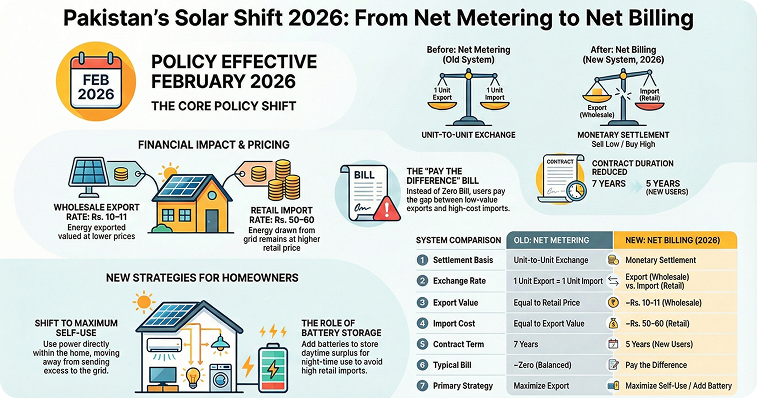
The new policy of net billing allows us to trade excess units at certain rates, which are different. On the other hand, in net metering, the rates of importing and exporting power units were the same. Earlier, we could send back the excess units’ production to the national grid. As a result, the bill would be zero.  

Take this example: if you use 100 units at night and export 100 units during the day, the bill would be zero. Now, new users will import units from the national grid at different tariffs, and the export rate will be roughly around Rs. 10–Rs. 11. The difference in balance will be reflected in a monthly bill. 

Also, the return on investment (ROI) and payback period will be affected. 

Impact on ROI and Payback 

The new policy will extend the time for return on investment (ROI). Earlier, the payback time for on-grid systems was 2–3 years. Now the same period is extended to 4–5 years. 

How to Maximize Your Benefit? 

Because of these changes, the most beneficial way to use solar systems in Pakistan is to adapt to hybrid solar systems

These systems not only allow you to maximize your reliance on solar through grid-tied and off-grid power availability, but they also allow homeowners to trade excessively generated electric power.  

This means that by mostly relying on a hybrid solar system, you will be able to consume the units generated by your home solar system in Pakistan. This will lead to lower power expenses. In addition, when your solar system generates more electricity than you need, you can trade it with the national grid. It will balance your national power consumption. 

Also, if you are a homeowner with an already installed solar system and you are in contract regarding net metering, your contract shall remain intact. However, if you are entering into such a contract after February 2026, you will get the new implementations effective immediately.  

What are the Potential Impacts of Net Billing Regulation 2026? 

The adaptation of net billing is gradual. However, the focal point is also to consider who will pay for the grid. The impact on the grid is also expanded to non-solar power consumers. Moreover, how does this shift push the households in the country? High tariffs and frequent power cuts are the primary reasons homeowners are adapting towards solar.  

Furthermore, how well hybrid systems align with the household needs in Pakistan is still to be explored in the coming years.  

Need Professional Help for Solar System Installation in Pakistan? 

To install a hybrid solar system in Lahore, Karachi, Islamabad, or anywhere in Pakistan, you need professional assessment and guidance to choose the most suitable option for your home. This option should also fit your custom power needs around the clock; that’s why it is also called a customized solar solution. 

For this, Zero Carbon—the best solar solution providing company in Pakistan—is your go-to solution for any questions, queries, size assessments, and requirement calculations. You can book a free survey with us. 

Conclusion 

One of the biggest drivers of the solar boom in Pakistan is power independence and the ability to sell excess power to the national grid. However, with the new NEPRA rules 2026, net metering has now changed to net billing. In this blog from Zero Carbon—the largest solar company in Pakistan—you can get all your answers. 

Frequently Asked Questions 

  1. What is the main difference between net metering and net billing?

Under net metering, the rates for importing and exporting electricity were the same, which often resulted in a zero bill if consumption and export were balanced. Under net billing, import and export rates are different—export rates are now around Rs. 10–Rs. 11 per unit, while import rates follow standard tariffs. The difference is adjusted to the monthly bill. 

  1. Who is affected by the new net billing policy?

The new net billing policy applies to new solar consumers who enter a contract with their relevant DISCO after the implementation of NEPRA Prosumer Regulation 2026 in February 2026. 

  1. How does the new policy impact return on investment (ROI) and payback period? 

Previously, the payback period for on-grid solar systems was around 2–3 years. With net billing, the payback period is now extended to 4–5 years, which affects the overall return on investment. 

  1. What type of solar system is recommended under net billing?

To maximize benefits under net billing, hybrid solar systems are recommended. These systems allow homeowners to rely more on self-generated power while still having the option to export excess electricity to the national grid. 

  1. Can I still reduce my electricity bill with net billing?

Yes, you can still reduce your electricity bill. By consuming the units generated by your solar system and only exporting surplus power, you lower your reliance on imported grid electricity. The exported units provide a credit at the applicable export rate, helping balance your overall power expenses. 

  1. Does net billing apply to existing net metering consumers?

According to the new policies, net billing is applicable for new solar consumers who enter into new contracts with the DISCO. Existing consumers may continue under the previous framework. However, once the tenure completes, they will have to enter a new contract. 

  1. Where can I get professional help installing a hybrid solar system? 

For professional assessment and installation, Zero Carbon—a leading solar solution provider in Pakistan—offers a variety of services, including size assessments, requirement calculations, and assistance in installation. You can also book your request for homeowners across the country. 
Lahore is evolving, and so is the definition of luxury. The story has moved beyond the grand facades and prime locations. These days, true prestige lies in more control and uninterrupted comfort. However, power disruptions are barriers to achieving this dream. This is where Zero Carbon—the best solar solution provider- delivers the definitive one-stop solution. To remove this barrier and experience luxury living. Embrace the lifestyle of modern living with a self-sufficient, uninterrupted power supply through hybrid solar solutions in Lahore.

Dream of a Life in Lahore

When the dream of living in Lahore is discussed, it means a blend of rich historical heritage, vibrant culture, modern luxury, convenience, and ease of access to national and international connections.

In the last decade, the city has seen incredible development and has numerous prime locations. From Gulberg to DHA, Model Town to LDA Avenue, the concept of luxury living has seen grand growth.

However, modern times bring modern anticipations. From primary locations to world-class facilities, luxury living today evolves around the uninterrupted living experience. Therefore, the elimination of power disturbances and disruptions is the primary concept of an uninterrupted living experience, free of any hurdles in day-to-day life at all levels.

Realities of Unreliable Power Supply  

Imagine you live in the beautiful home you hard-earned in Lahore, and there you sit idle during peak hours because of load shedding. Mental agony, waste of time, and energy are common results of power outages.

High electricity prices, hefty bills, high dependence on the national grid, and energy shortages due to several reasons in tough weather are some of the common problems across the country, and Lahore is no exception.

Ironically, national grids are an unreliable power source, especially in harsh weather conditions. The gap between demand and supply is increasing insanely. Hence, no matter how elite your society is, without an independent power source, your lifestyle, peace of mind, and health will be compromised.

Experience the Luxury Living with an Independent Power Supply

The only solution to live a tension-free and truly luxurious life in Lahore is to become free from reliance on the national grid. For the last five-six years, Pakistan has been massively investing in solar systems across the country.

However, depending on the types of solar systems, your power supply would be partially available. With on-grid, you can use solar power during the day, and with off-grid, you can use your solar power till your solar batteries allow.

So, what is the complete source of uninterrupted power supply to experience luxury living in Lahore? — Hybrid Solar Solution!

Hybrid Solar Solution

A hybrid solar solution is a one-stop solution for discerning Pakistani homes Businesses, and industrial setups can also benefit from hybrid solar systems. These systems are the most intelligent form of solar systems and can provide you with a power supply without any hurdles or breaks, at any time of day, and in any weather conditions.

With a hybrid solar system, you will have power generation through solar panels, which you can use during the daytime, just like an on-grid solar system. Further, the excessive power will be converted and stored in the hybrid batteries that will be useful for your house, just like the off-site solar system.

In this solar setup, you will be equally able to use the net metering benefits. The decision to install a hybrid solar system would lead you towards a luxury living in Pakistan.

How a luxury life in Lahore looks like

Imagine a Day with Uninterrupted Power at Home

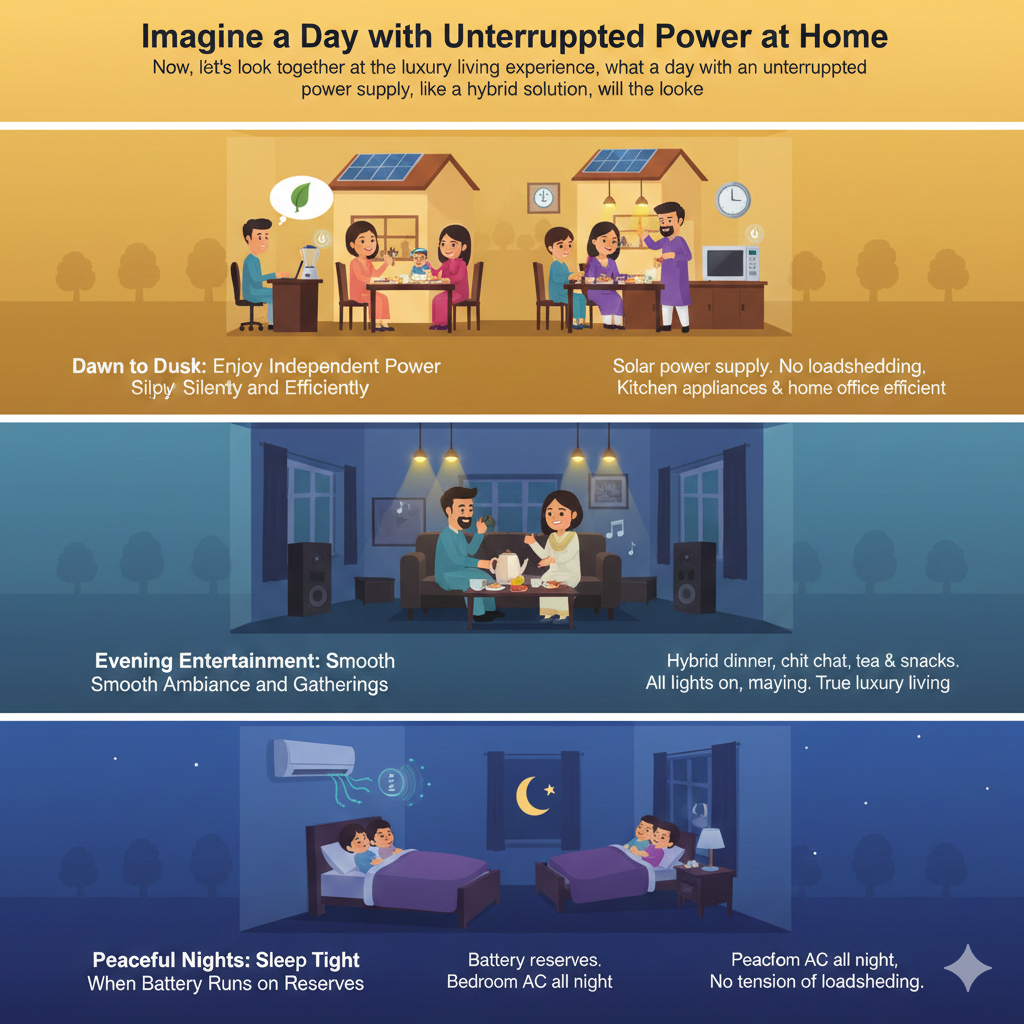
Now, let’s look together at the luxury living experience, what a day with an uninterrupted power supply, like a hybrid solution, will look like.

Dawn to Dusk: Enjoy Independent Power Supply Silently and Efficiently

Imagine that as the sun rises, your hybrid solar system gets its power supply through sunlight. There are no problems with loadshedding, unannounced power cuts, or voltage disruptions. Your family is enjoying breakfast of your choice. Throughout the day, your kitchen appliances and your home office all work efficiently.

Evening Entertainment: Smooth Ambiance and Gatherings

Now, as the evening arrives, the hybrid solar solution performs at its peak. Your family comes together, enjoys a dinner followed by a chit chat session, with tea and snacks. With all the lights on and music playing in the background, you can enjoy the true essence of luxury living.

Peaceful Nights: Sleep Tight When Battery Runs on Reserves

During the last part of the day, your hybrid solar system will be working on the reserves your batteries have kept. With its reserves, your bedroom AC runs all night, and you sleep peacefully, free from the tension of load shedding and fast meter runs. What else is the luxury of living without a peaceful and restful sleep?

Get Premium Hybrid Solar Solutions for Your Locations

Now that you know how you can experience the luxury living with a hybrid solar system in Lahore and across Pakistan. Why look any further? Get your interest registered with us at Zero Carbon. Schedule a complimentary, personalized consultation with Zero Carbon experts and get all the information regarding size, technology, and any concerns you may have.

Conclusion

Lahore is not only the heart of Pakistan, but also the city of dreams. The city is evolving at a fast pace, and you can undoubtedly enjoy the luxury living today with a hybrid solar system.

Frequently Asked Questions (FAQs)

How does it perform in Lahore’s weather (e.g., cloudy days, monsoon)?

Hybrid solar systems are designed for resilience. On sunny days, they generate and store ample power. On cloudy or rainy days, they draw from the battery reserves charged previously. The hybrid solar system intelligently manages energy to ensure supply, and the grid connection acts as a final safety net, making it reliable in all of Lahore’s seasons.

What maintenance is required for a premium hybrid solar setup?

Minimal maintenance is a key benefit of hybrid solar solutions. Solar panels only require occasional cleaning. The hybrid inverter and batteries are largely maintenance-free.

Zero Carbon provides comprehensive after-sales support, including monitoring and maintenance packages, to ensure your system performs flawlessly for decades.

How long will the system, especially batteries, last?

High-quality solar panels have performance warranties of 25+ years. The lifespan of premium hybrid batteries (like Lithium-ion) are typically 8-12 years, depending on usage and technology. We use only tier-1, durable components with strong warranties to protect your investment.

Why should I choose Zero Carbon over other providers in Lahore?

Zero Carbon specializes in bespoke energy solutions for luxury homes. We don’t just sell systems; we design integrated lifestyle upgrades. Our difference lies in:

Custom Design: Tailoring every system to your specific consumption and aesthetic preferences.

Premium Components: Using only world-class, silent, and efficient technology.

White-Glove Service: From consultation to installation and ongoing support, we provide a seamless, premium client experience.

Expertise: Deep understanding of the unique power challenges and architectural considerations of Lahore’s elite communities.

What is the next step to getting a system for my home?

The journey begins with a complimentary, personalized consultation. A Zero Carbon expert will visit your home, understand your lifestyle and energy needs, assess your property, and then present a tailored proposal. There is no obligation. Simply contact us to schedule your consultation and take the first step toward redefining your luxury living experience

Installing solar systems at home is a very attractive option due to its benefits in Pakistan. The advantages are not limited to gaining independence in power generation, but also the homeowners can save money through the legally adaptive process of net metering in Pakistan. However, in February 2026, the regulatory body revised the policy and introduced the concept of net billing. The following article will share all elements of this policy, what you must know, and how this will impact savings and solar implementations for homeowners specifically. Let’s start.

What is Solar Power Net Metering?

Net metering is a billing mechanism allowing solar owners to sell excess electricity to the national grid. In Pakistan, net metering was regulated under the Net Metering Regulations 2015, which carried out identical rates for importing and exporting electricity.

Furthermore, homeowners with installed solar systems have the advantages of being power independent, remaining capable of earning through excess power production, and enjoying the elevated value of their physical asset—their home.  Earlier, net metering was regulated under the Net Metering Regulations 2015. However, the national power body introduced the NEPRA Prosumer Regulation 2026. This regulation replaces net metering with net billing. Moreover, it regulates solar, wind, and biogas power systems.

What is Net Billing in Pakistan?

Net billing is a concept now applicable to new solar consumers who enter into a new contract with the relevant DISCO. However, over time, existing consumers will also be subject to this contract.

Variations Between the Policies

The new policy of net billing allows us to trade excess units at certain rates, which are different. On the other hand, in net metering, the rates of importing and exporting power units were the same. Earlier, we could send back the excess units’ production to the national grid. As a result, the bill would be zero.

Take this example: if you use 100 units at night and export 100 units during the day, the bill would be zero. Now, new users will import units from the national grid at different tariffs, and the export rate will be roughly around Rs. 10–Rs. 11. The difference in balance will be reflected in a monthly bill.

Also, the return on investment (ROI) and payback period will be affected.

Impact on ROI and Payback

The new policy will extend the time for return on investment (ROI). Earlier, the payback time for on-grid systems was 2–3 years. Now the same period is extended to 4–5 years.

How to Maximize Your Benefit?

Because of these changes, the most beneficial way to use solar systems in Pakistan is to adapt to hybrid solar systems.

These systems not only allow you to maximize your reliance on solar through grid-tied and off-grid power availability, but they also allow homeowners to trade excessively generated electric power.

This means that by mostly relying on a hybrid solar system, you will be able to consume the units generated by your home solar system in Pakistan. This will lead to lower power expenses. In addition, when your solar system generates more electricity than you need, you can trade it with the national grid. It will balance your national power consumption.

Also, if you are a homeowner with an already installed solar system and you are in contract regarding net metering, your contract shall remain intact. However, if you are entering into such a contract after February 2026, you will get the new implementations effective immediately.

What are the Potential Impacts of Net Billing Regulation 2026?

The adaptation of net billing is gradual. However, the focal point is also to consider who will pay for the grid. The impact on the grid is also expanded to non-solar power consumers. Moreover, how does this shift push the households in the country? High tariffs and frequent power cuts are the primary reasons homeowners are adapting towards solar.

Furthermore, how well hybrid systems align with the household needs in Pakistan is still to be explored in the coming years.

Need Professional Help for Solar System Installation in Pakistan?

To install a hybrid solar system in Lahore, Karachi, Islamabad, or anywhere in Pakistan, you need professional assessment and guidance to choose the most suitable option for your home. This option should also fit your custom power needs around the clock; that’s why it is also called a customized solar solution.

For this, Zero Carbon—the best solar solution providing company in Pakistan—is your go-to solution for any questions, queries, size assessments, and requirement calculations. You can book a free survey with us.

Conclusion

One of the biggest drivers of the solar boom in Pakistan is power independence and the ability to sell excess power to the national grid. However, with the new NEPRA rules 2026, net metering has now changed to net billing. In this blog from Zero Carbon—the largest solar company in Pakistan—you can get all your answers.

Pakistan is the country with maximum sunlight in the world. Ironically, the country also faces huge social, economic, and mental issues due to massive power problems. To solve these, the nation tried to find a solution with the help of natural resources. Hence, we have been one of the largest solar energy consumers in the world. With time, innovation keeps the spark alive. Let’s explore how hybrid solar systems for Pakistani homes in 2026 is an ideal choice to make.

Solar Needs of Pakistani Homes

Pakistani homes are very different from those in the rest of the world. In terms of their location, climate, structure, design, size, usage, and affordability are far different from those in the UK, US, and other Western countries.

Therefore, all these factors heavily impact the power needs of homes in Pakistan. Similarly, solar needs are also dependent upon the usage and customized needs. Moreover, solar needs for Pakistani homes are also different from the rest of the world based on the following factors.

  • High Temperature Tolerance
  • Battery Dependable Systems
  • Rapid Payback
  • High-Capacity Usage
  • Regulatory Changes

How Pakistani Homes are Different from Homes Located Elsewhere

In addition to all these factors, Pakistani homes are different from homes located anywhere else in the world. In Pakistani homes, the primary need to install any power supply should fulfil the requirement of reliability and power bills on the lower side. Whereas in other countries, like the USA and North America, the primary requirement is environmental safety and low power bills.

Furthermore, the climate is very different in Pakistan and that in the western side of the world. Due to intense heat and dust, the solar systems for Pakistani homes need to be robust. On the other hand, the western climate is mostly cold and cloudy, so the power needs to be efficient to be on the brighter side.

Moreover, the hybrid solar systems for Pakistani homes are to be installed on the rooftops. This case is similar to all solar systems installed for homes.

The difference here is the structure of roofs in Pakistan and in the rest of the world. In urban Pakistan, the rooftops are flat; in contrast, the west have pitched and tiled roofs with diagonal designs. However, in northern Pakistan, the roofs are also sloping and structurally different.

Problems in the Traditional Power Supply in Pakistan

Let’s explore the typical power problems Pakistan faces at the residential level. Moreover, we will explore how hybrid solar systems for Pakistani homes are a great option to solve these issues in a productive and cost-effective manner.

For decades, Pakistan has been prone to long hours of load-shedding. Moreover, power prices have seen a sharp rise. In Pakistan, the traditional power is received by the main power feeder that is connected through the national grid. Per unit prices have seen a lot of diversion of price over the years.

However, in 2026, the traditional power setup is divided into different consumption slabs, and the status of protective and unprotective consumers is settled on the basis of low and high consumers. Moreover, frequent fuel price adjustments are a part of this system. Moreover, the national grid distributed electricity through the regional DISCOs.

How are Hybrid Solar Systems in Pakistani Homes Ideal?

Hybrid solar systems are an ideal solar solution for homes in Pakistan. It provides an interrupted power supply during heavy load-shedding hours. Furthermore, hybrid solar systems for Pakistani homes support the primary need of the middle-class, especially in Pakistan, the cost control. Moreover, it also helps reduce grid dependence to meet the power needs.

Furthermore, the hybrid solar systems for Pakistani homes work on three main components. These components include batteries, solar panels, hybrid inverters, and solar panels installed on the rooftop.

A hybrid solar system for Pakistani homes is an option not to be missed if you want to live an easy and peaceful life, while meeting your energy needs without the tension of increased prices. It will also remove your barriers to using energy for your happy home. Currently, Pakistan has more off-grid solar solutions installed in the residential economy than on-grid solar solutions that are somehow documented. By 2025, the country will import 50GW of power.

Get Professional Guidance and Installations Through a Call

ZERO Carbon is a customized solar solution provider in Pakistan. Now offering Hybrid solar systems for Pakistani homes. Our specialized staff is ready to serve you from plan to execution. All you have to do is book a call.

Wrap Up

Hybrid solar systems for Pakistani homes are the ideal choice to make for a major investment in your home. It will not only solve your power problems, but also do so in the best way possible. It will help you consume the power your home needs for optimal usage. This is also possible with a price cut and a reduction in the reliance on the national grid.

Frequently Asked Questions (FAQs)

What exactly is a hybrid solar system, and how is it different from on-grid or off-grid?

Answer: A hybrid system is connected to the grid and uses a battery backup. It intelligently prioritizes using solar power for your home, storing excess in batteries, and only exporting to the grid or drawing from it as a last resort. (On-grid has no batteries; Off-grid is not connected to the grid at a

What are the main advantages of a hybrid system over a standard grid-tied system?

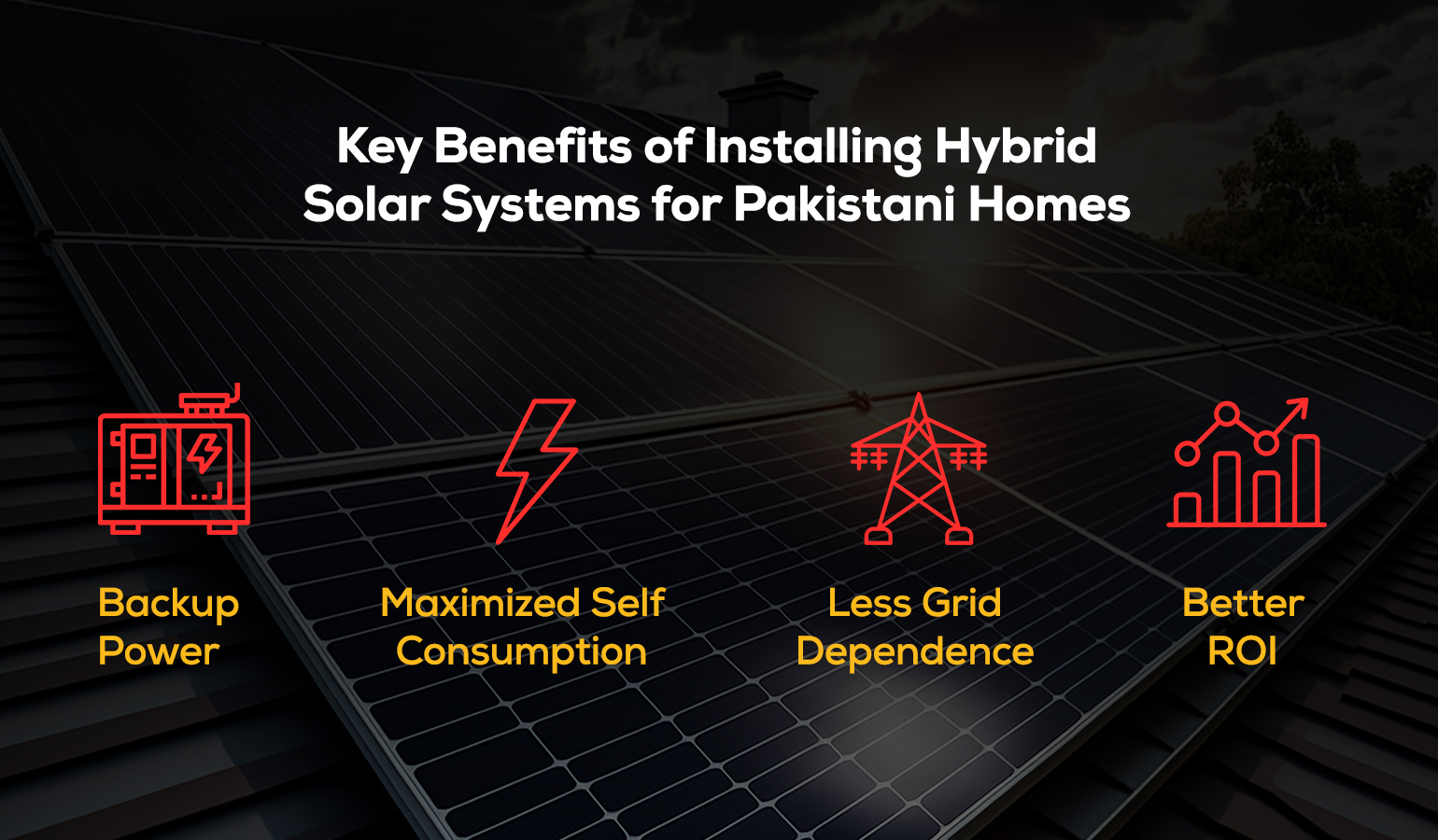
Answer: Key benefits are Backup Power (during grid outages), Maximized Self-Consumption (use your own solar day and night), Less Grid Dependence, and often better ROI in areas with Time-of-Use billing or poor net metering policies.

How well will it work on cloudy/rainy days?

Answer: You will generate less solar power, so the system will rely more on the stored energy in your batteries. Once batteries are depleted, it will seamlessly draw from the grid (if available). Proper sizing accounts for several days of autonomy.

Will I have power during a blackout?

Answer: Yes, this is a key feature. The system automatically isolates from the grid (anti-islanding) and powers your home from batteries + solar. Important

How to Buy Hybrid Solar Systems for Pakistani Homes?

You can contact Zero Carbon for a free survey. The professional staff will guide you from size to execution.

In recent years, renewable energy has been one of the most pursued topics across the globe. Solar energy is the most adopted type of renewable energy source. The reason behind this quick adaptation and power shift is the feasibility for the users with longevity of benefits and the ease in meeting the energy demands. Furthermore, the positive impact on the climate is also a big supporting point for people to shift towards solar energy over the last decade. This article will share some of the fascinating facts you should know about solar energy.


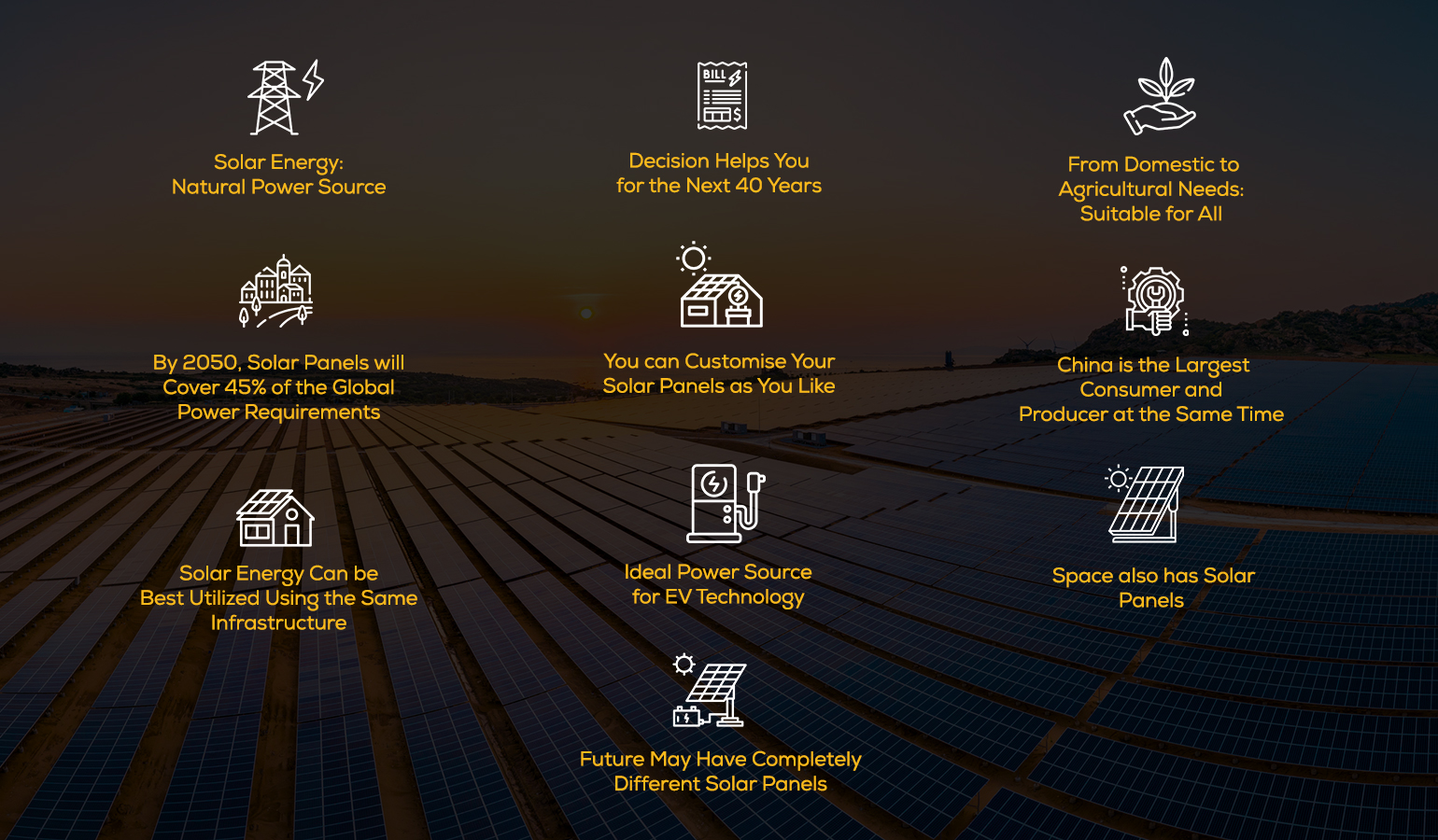
  1. Solar Energy: Natural Power Source
  2. Decision Helps You for the Next 40 Years
  3. From Domestic to Agricultural Needs: Suitable for All
  4. By 2050, Solar Panels will Cover 45% of the Global Power Requirements
  5. You can Customise Your Solar Panels as You Like
  6. China is the Largest Consumer and Producer at the Same Time
  7. Solar Energy Can be Best Utilized Using the Same Infrastructure
  8. Ideal Power Source for EV Technology
  9. Space also has Solar Panels
  10. Future May Have Completely Different Solar Panels

Zero Carbon brings these facts for you to know and learn while you decide to get the best out of your solar panels. And yes, you can also decide what you need to know before opting for a solar setup at your location.

Solar Energy: Natural Power Source

Let’s start with the most interesting fact. As we have discussed, renewable energy is in action globally due to its benefits. The biggest advantage is that renewable energy is free of the climate-damaging carbon footprint. Solar energy and wind energy are the two major types of renewable energy.

Solar energy is derived from sunlight, which is a natural source of power and light. Moreover, its long hours of presence across the world make solar energy the top and reliable power source. This case applies in countries like Pakistan, because of the ideal physical location of this south asian paramount of nature’s miracles.

The power we obtain from the sun can be converted and utilised as regular electricity with proper installation. In this way, Pakistan can easily overcome its energy crisis. Due to its efficiency and effectiveness, Pakistan has rushed towards solar energy. From homes to agricultural farms, we can see solar panels installed everywhere in major cities like Lahore, Islamabad, and Karachi.

Decision Helps You for the Next 40 Years

Installing a solar system in your home, industrial site, corporate location, or agricultural farm is a major financial decision. Though solar is a feasible option, however, it takes a lot of effort, some cash, guidance and installation expenses before it becomes operational.

In Pakistan, not many people have a clear idea about how solar panels work and how beneficial they are. Therefore, they stay in a state of confusion, whether to take this decision or not. You would be glad to know that the solar panels are a one-time investment, low-maintenance,  and eco-friendly device.

Once you install a high-quality solar system at your location, the solar panels will pay off for the next three to four decades. It also increases the value of your physical property. Hence, if you are a homeowner looking to install a solar system, and you want to rent it out or sell it away. Your solar system will pay you more bucks, because the independent power-providing house is an apple of the eye in the real estate market.

From Domestic to Agricultural Needs: Suitable for All

The solar panels combine to make the solar system. There is no limitation to the location for its benefits. Hence, you can install and utilise solar energy to fulfil the domestic power needs, commercial needs, and corporate power requirements, as well as the needs of farms and agricultural setups.

Therefore, it is a fact that no one size fits all, but solar energy is a great suitable-for-all solution as per the size of a solar system, fulfilling the power demands and energy needs.

By 2050, Solar Panels will cover 45% of the Global Power Requirements

Another fact you would be delighted to know is that solar energy is being adopted across the globe. Countries like the US, China, Canada, and Pakistan are among the biggest adapting countries in the world.

Keeping the progress in count, it is anticipated that by 2050, around 45 percent of the global power needs would be matched by solar energy.

You can Customise Your Solar Panels as You Like

Technology is evolving rapidly. Similarly, solar production and efficiency with effectiveness are getting better with time. The solar panels are becoming more powerful, effective, and safe for the future. That’s not just all, the solar panels in the near future are also coming with the option to have the preferred design and color.  Transparent and Pink colored-solar panels are the anticipated options of the future with the applications of dyes, paints and creatives. We are still in awe of possibilities.

10 Good-to-Know Facts About Solar Energy

China is the Largest Consumer and Producer at the Same Time

Next on the list of good-to-know facts about solar energy is that China is the largest consumer of solar energy in the world. The US is second on the list. Germany, India, and Japan follow.  China obtains 32 percent of its power needs from clean energy. At the same time, China is the largest producer, supplier, and exporter of green energy technology.

On the other hand, if we talk about Pakistan, we have adopted solar energy in an unprecedented way. In 2024, Pakistan became the third-largest importer of solar panels from China. The future of solar energy is bright in Pakistan, as we have discussed earlier on the Zero Carbon blog.

Solar Energy Can be Best Utilized Using the Same Infrastructure

Often, to adapt to the latest technological advancements, infrastructural upgrades are necessary. However, obtaining electricity from solar energy does not require any infrastructural upgrade to your home, office, or corporation etc.

The only thing required is the accurate installation of the solar system, and its proper linking up as a power supply to the physical location. You may look for options like on-grid, off-grid, and hybrid solar systems to see the solar system options. Solar energy can work through retrofitting on the existing infrastructure.

Ideal Power Source for EV Technology

An Electric Vehicle is the modern mode of transport. New vehicles like cars, scooters, and even public transport modules like trams and buses are now powered by electricity. This is a new way of eco-friendly practices, reducing the carbon footprint by the burning of petrol, diesel, and coal.

To make the electric vehicles more practical, charging stations are needed for charging. In this regard, solar energy can power EV charging in an eco-friendly way through the natural source of power. That’s why it is an ideal power source for EV Technology.

Space also has Solar Panels

Man is a smart species. We are not only benefiting from the natural source of energy on the face of the earth, rather we have also taken solar-powered equipment into space. The equipment, spaceships, and satellites are heavily relying on solar energy. This helps the missions to complete their job without fuel consumption.

Future May Have Completely Different Solar Panels

Solar Panels and solar system structures use materials like silicon, silver, and indium. These materials are extracted from the Earth’s core. With time, there is a possibility that these may vanish with time. Therefore, the manufacturing of solar systems will shift to other materials, which will be even better. Hence, it is highly possible that future solar energy would be saved and consumed differently.

Conclusion

Solar energy is the truth and an easy access to the energy needs. It not only supports the environment, but it also efficiently uses the free and abundantly available source of power-SUN LIGHT. The lesser-known facts about solar energy are a part of this article. Stay tuned for such articles in future with zero carbon.

Solar panels produce environmentally friendly electricity that is generated through sunlight. Therefore, the summer sunny days in Pakistan are ideal for solar panels and solar systems. However, you may wonder what and how productive solar panels on rainy days are? Pakistan also has an intense episode of rainy days during July-August every year. Zero Carbon shares how solar panels work on rainy days. Efficiency and safety tips are a part of this article shared by Zero Carbon.

How Does the Solar System Work?

Solar systems work in the sunlight. It absorbs sunlight and converts it into usable electricity. Solar power is a clean energy source. It is very environmentally friendly and reduces carbon prints, turning the energy into green energy.

Due to its reliance on sunlight, Pakistan has an ideal country profile, weather profile for solar systems operations. We have the longest sunny days, and hence we can benefit from the solar systems in diverse ways.

Hence, currently, the country is experiencing a solar rush. Heavy residential solar systems, industrial installations, commercial usage and notable agricultural installations are the new normal in Pakistan’s solar energy adaptation.

Do Solar Panels Work on Rainy Days?

Keeping the essential need of sunlight, it is often asked if solar panels work in extreme weather. Absurd weather could be anything from cloudy to rainy and with heavy hailstorms to thunderstorms.

The answer is Yes, solar systems do work on cloudy days, even on rainy days. However, the types of solar systems may vary. The on-grid, off-grid, and hybrid solar systems are some of the adaptable and available options for users worldwide and in Pakistan.

However, efficiency reduces by 10% to 15% on rainy days and even on cloudy days. Furthermore, it is important to know that the on-grid solar systems can work efficiently during sunny days and during the daytime. Though you will need battery support for cloudy days, rainy days and hailstorms.

Furthermore, it is also essential to take precautionary measures during weather conditions like cloudy weather, hailstorms, and rainy days. In the following, we are going to share some tips with you to keep your solar systems, solar panels and batteries safe and secure during the hard-weather days.

solar panels on rainy days

How to Ensure the Safety of Solar Panels on Rainy Days?

Though solar systems are a large system and we cannot move them like a briefcase in an hour of need. The good news is that you can safeguard your solar system on rainy days.

However, the good news is rain is not damaging to the solar panels and their structure. However, some elements like dust, debris, or tree roots can cause some inconvenience. To handle all this, you can get some tips as follows.

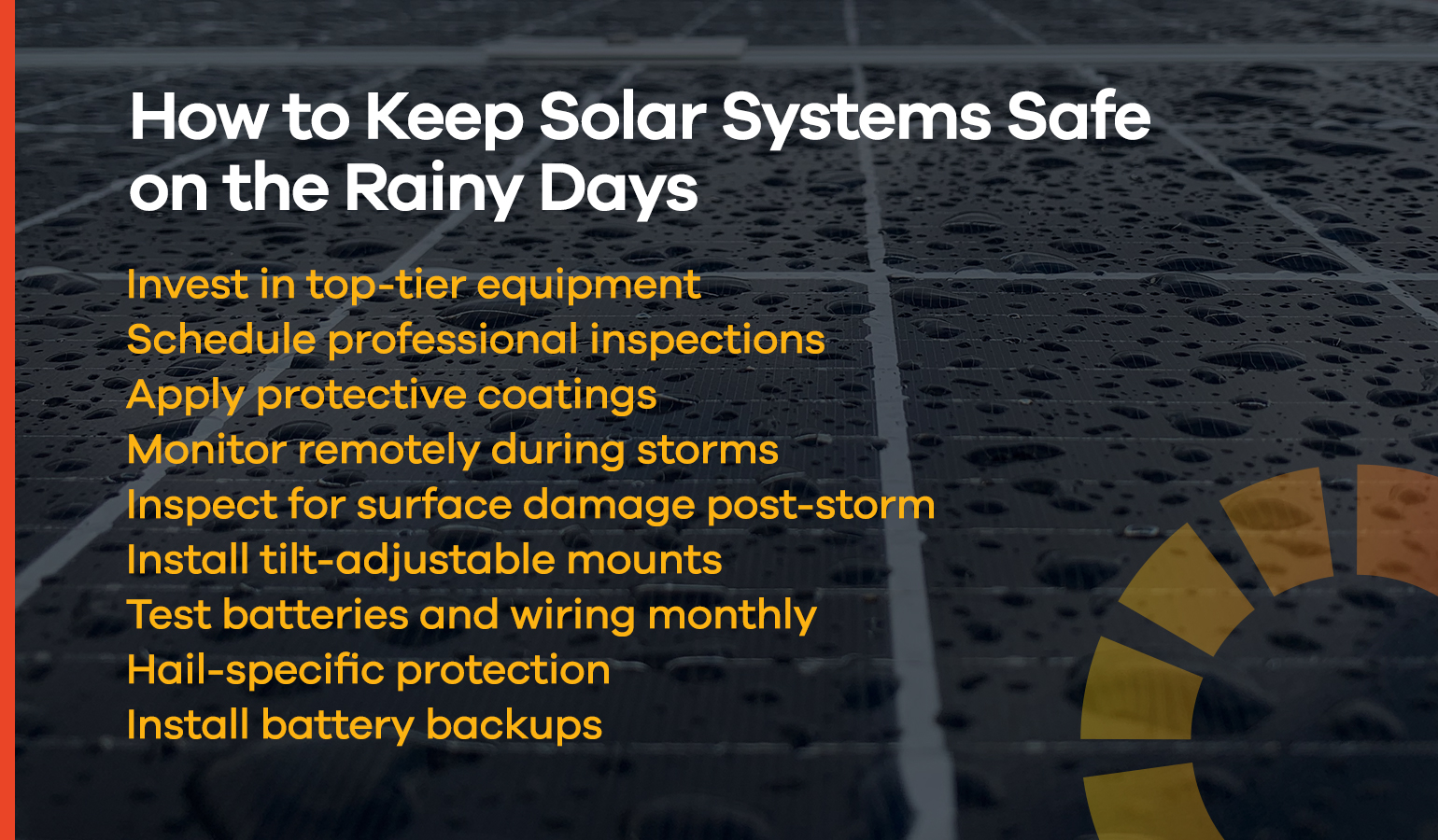
  1. Use top-quality solar panels and installation materials.
  2. Perform regular inspections of your solar system.
  3. You should also apply the safety coat on your solar panels. This will help in heavy rain and hailstorm days.
  4. Check your solar system and solar panels in the rain if possible.
  5. Ensure you make a visit to check out solar systems that are free from any surface damage.
  6. Use the tiltable solar panel modules to change the angle of solar panels in thunderstorms or rainstorms.
  7. Check the batteries and installation wires regularly. Do this regularly in the rainy season to inspect and get any breakout in time and before damage.
  8. Call the solar system installers to make a visit to ensure your solar panels are safe, secure and efficient these days.
  9. You can get more tips about safeguarding your solar panels in hailstorms.
  10. If you need solar system energy after the daytime, and uninterrupted during rainy or cloudy days, install battery systems also.

Optimize the Solar System Power Production on Rainy Days

You can also optimize energy production on rainy days. The major factors to keep in mind to obtain the maximum output from your installed solar systems are listed below.

  • Select the Open Area for solar panel installation
  • Intelligently Calculate the Size for your Solar Systems

Choose your solar system after doing thorough market research. It is important that you know your budget and your need for electricity. It is always a great idea to calculate the average power needed and to install an expanded solar system on your physical location.

This factor is most beneficial in the long term for residential solar power consumers. However, commercial, industrial, and agricultural users can expand with time after the requirement increases.

Coming back to optimize your solar power production on rainy days. You must install your solar panels in an open space. The more it is free from any shade, the more chances there are that solar systems will work efficiently.

Next is to calculate the need for your solar system as described above.

Do You Need Any Professional Assistance?

If you are looking for any professional guidance, assessment to calculate your solar needs, to know the ideal size for your solar systems, and to get expert help in installations, and if you are wondering is your location is workable with the solar systems. You can get free assistance from the best solar company in Pakistan to know the performance of solar panels on rainy days. Zero Carbon is just a call away.

Conclusion

Solar panels on rainy days are some of the most curious questions people ask. This article at Zero Carbon helps you understand the phenomenon, and the efficiency of solar panels and solar systems on rainy days and other absurd weather conditions.

In most parts of the world, solar power is a great renewable energy solution. Solar net metering in Islamabad has been around for decades, and it’s proven to be an effective way to create sustainable and affordable electricity by harnessing the sun’s power. The benefits of this system include:

  • Lower electricity bills.
  • Fewer greenhouse gas emissions.
  • Less dependency on fossil fuels.
  • More freedom from utility companies.

Islamabad should adopt solar net metering because it would be financially beneficial for them and environment friendly.

What is Solar Net Metering in Islamabad, and How Beneficial Is It?

Solar net metering in Islamabad is a system that credits solar electricity production at the end of each month for excess energy not consumed by the home. It reduces dependency on utility companies and encourages sustainable living.

Solar Net Metering in Islamabad can reduce the dependency of Citizens on Fossil Fuels

The citizens of any country normally are not happy with the government’s decisions to increase fuel prices. They have been involved in protests as well and their unhappiness has led them to think about alternative ways to generate energy. Solar net metering in Islamabad is one option that could be a good solution for Islamabad residents who want to reduce their dependency on fossil fuels. This blog post will explore solar net metering, why it might be a good idea for Islamabad residents, and how it can work there.

The costs of installing solar panels are not high nowadays, but they will eventually pay for themselves over time with reduced monthly electric bills and lower operational costs.

Solar Net Metering in Islamabad is Viable Option

A recent study by the World Bank and International Finance Corporation (IFC) has found that solar net metering or electricity production through solar power could provide a viable option for Pakistan’s growing demand for electricity. The report suggests that to ensure sustainability, the country should promote renewable energy sources such as solar power, which can be generated locally and is less expensive than importing coal or natural gas. With proper implementation, the report forecasts an increase in installed capacity of 100 MW to 400MW within three years and even more after five years.

Solar Net Metering Can Work as A Good Substitute for Saving Electric Power.

The capital of Pakistan, Islamabad, needs a new source of electricity. The current power grid is unreliable, and the city needs to find an alternative way to provide energy for its residents. One option that will help save money in the long run while providing clean, renewable energy is solar net metering. This blog post highlights how Islamabad can adopt this technology and what benefits it will bring the citizens who live there.

Solar Net Metering in Islamabad, a Good Replacement for Electricity Shortages

The people of Islamabad, Pakistan’s capital city, face electricity shortages or they often seem worried about high electricity prices. The government also took some drastic measures to get the power back on for its citizens by rationing electricity during peak hours and banning water pumps from running between 11 pm and 4 am. But these are just temporary measures and these steps are not very beneficial for the public.

However, we strongly believe that solar net metering is a better solution to their energy needs. With this system, residents can install solar panels at home to generate clean power, which they can then use or sell back to the grid through small meters installed on each board. It is an environment friendly option and saves money as it reduces reliance on expensive diesel generators during times of shortage.

Solar Net Metering in Islamabad Means Not Paying Too Much Electricity Bills.

If you are in Islamabad, Pakistan, then there is a good chance that you are paying too much for your electricity bill. With the average high cost of electricity and almost half of Islamabad’s population having no access to grid power, solar energy could be the perfect solution.

The Pakistani government has recently announced plans to increase its solar capacity from 100MW to 1GW by 2022, which will help them meet their renewable energy targets and bring down costs for consumers who have been hit hard by inflation over the past year. There are some local private companies which have already started the solar installation services in Islamabad. It is the right time to enjoy benefits after installing solar panels at homes or offices.

Solar Net Metering in Islamabad Should Be Considered as Part of the Energy Mix.

With the rising cost of electricity and concerns about global warming, more and more people are looking towards renewable energy options. Solar power is one such option that has been around for a long time, but it’s starting to get new attention as prices come down and governments look at ways to cut back on carbon emissions. Pakistan citizens should consider solar net metering as part of its energy mix.

Conclusion:

 Solar net metering in Islamabad will also give you an attractive option to get paid for extra electricity units that you add to the grid. In some cases, the power grid measures how much you use and will pay for any surplus not used at your home or business. It means that even if you are unable to afford a complete system now, over time, as more panels become available, you can save money by investing in this technology. You may also be able to get incentives from the state government, making it easier on your wallet! If you’re interested in learning about other ways to go green with your electricity bill, feel free to contact our team today. We would love to help set up an appointment for someone who wants proper guidance on it.

The capital city of Pakistan and the province of KPK were hit by a drastic hailstorm in the third week of April,2025. The hailstorm lasted for more than 30 minutes and destroyed many valuable vehicles, properties, and installed solar panels. The total estimates are yet to be made, however, many people are in line to get their windscreens, solar systems, and household repairs.  Zero Carbon- the top solar company in Pakistan is sharing this write-up for you to ensure solar panel protection against hail in Pakistan.

How Common are Hailstorms in Pakistan

Hailstorms are not a very frequent or common weather phenomenon in Pakistan. However, Pakistan ranks among the top ten countries at risk of facing the consequences of global climate change.

However, in recent years, Pakistan has been facing floods, heavy rainfalls, and serious warnings like droughts. Likewise, the province of KPK and Islamabad experienced drastic hailfall, leaving four dead, and damaging properties and vehicles of the citizens in a duration of around half an hour.

Many cars had dents, broken windscreens, and household windows, and even solar panels were damaged due to the large size, high velocity, and frequency of the hail. Many citizens left scared. Furthermore, similar warnings are also issued by the Pakistan Meteorological Department.

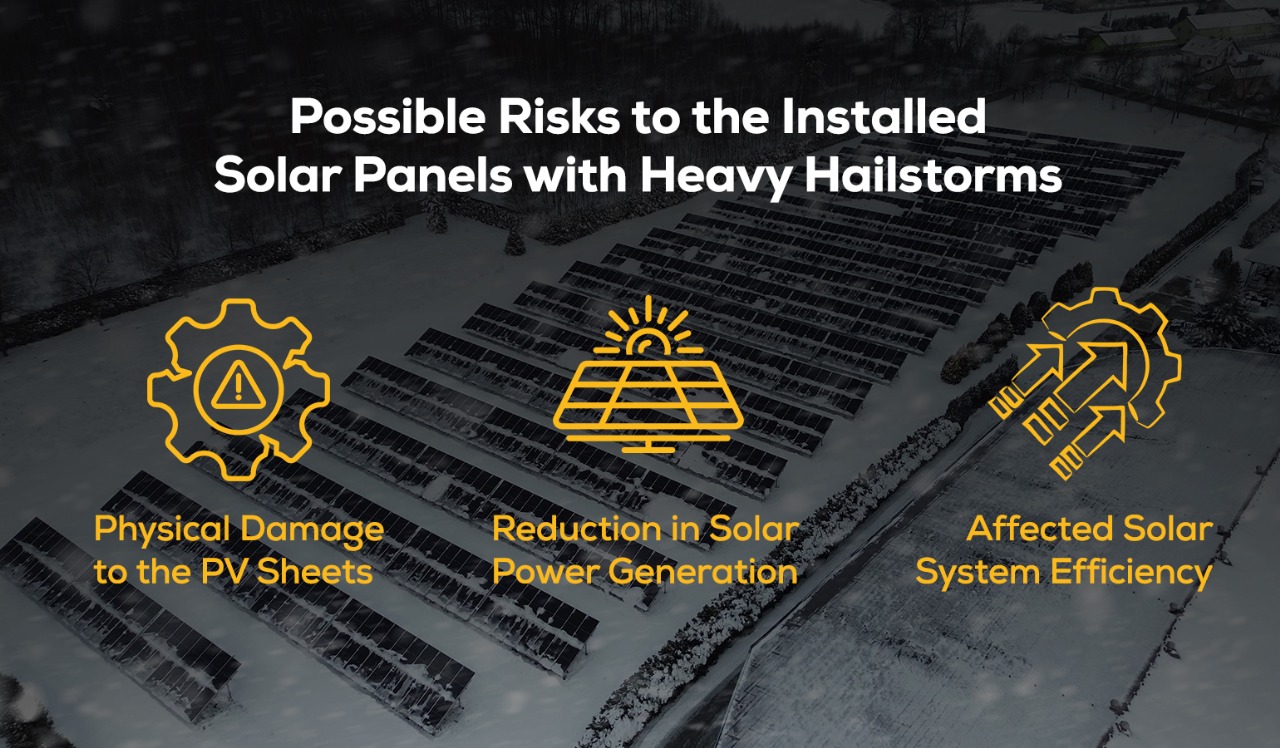
What are the Possible Risks to Installed Solar Panels?

Solar systems are a durable and long-lasting investment. Still, heavy hailstorms can affect and damage the solar panels physically, affect their productivity, and reduce their efficiency of solar power generation. However, the situation is more critical and concerning in the countries where snowfall, hailstorms, and frequent falls of snowballs occur.

As far as Pakistan is concerned, the situation is uncertain, especially due to the consequences of global climate change. However, there is a wise saying: prevention is always better than a cure! Zero Carbon brings certain tips to provide solar panel protection against hail in Pakistan. You can apply for any of the following tips, as they may suit your needs.

Ensure Solar Panel Protection Against Hailn

The first step to protect your solar panels is to see which hail is necessary to avoid. The good news is that solar panels are a durable and resilient product. Hence, only large snowballs and heavy hail can damage the solar panels. The worst weather conditions may lead to the worst results.

Therefore, whether hail could damage the solar PV panels depends on two factors.

  • Size & Diameter of Hail
  • Velocity of Hail

Next is the quality of the solar panels installed. Therefore, it is essential to buy high-quality solar panels from reputable solar power companies in Pakistan.

In addition to these factors, some tips could be helpful for solar panel protection against hail.

Choose Top-Rated & High-Quality Solar Panels

If you are new to buying solar panels or looking to upgrade your solar system, always go to a rated, reputed, and registered solar panel company in Pakistan. The one that offers high-quality, certified solar panels.

Some of the best solar panels in the Pakistani market are Canadian Solar, Trina Solar.  Also, ask your solar solution provider to arrange the top-rated solar panels for your properties. It would be delightful to know that at Zero Carbon, solar panels are professionally installed. These are an ideal renewable power source for electricity generation.

Solar Panel Installations are the Crucial Factor

While you are looking to install solar panels installed at your rooftop for residential solar or in an open field, ensure to follow a complete installation. Proper installation is an essential part to get the most out of this major decision and financial dip.

It is important to know that hailstorms will damage or destroy the solar panels if it is installed at 90 degrees. Therefore, while you are making an installation expense, always opt for the tiltable solar panel modules. In this way, if the weather situation worsens, you can take immediate action to guarantee solar panel protection against hail in Pakistan.

Furthermore, you can also explore the reinforced mounting systems. These two alterations, or proper installations, can help you to protect your solar panels against hailstorms anywhere in the world, including Pakistan.

Now, if you wonder how to get the best fitting, durable, and sturdy frames. You can contact professional teams, like Zero Carbon, which offers a free survey on solar system installations.

Use of Protective Covers

Next on the list to get solar panel protection against hail is the use of protective covers. The protective covers are also known as hardcovers. This product is ideal for solar panels if you plan to let them sit idle for some time. There are four types of protective covers.

  • Hail Covers
  • RV Solar Panel Protection Covers
  • Traps
  • RV Covers

However, the drawback with protective covers is that it does not let the sunlight pass and touch the solar panels. Therefore, no renewable solar power could be generated if the hardcovers are on the PV solar panels. This is another product to empower solar panel protection against hail.

Spray the Layer of Methacrylate

Another cost-effective and useful option for solar panel protection against hail is the Methacrylate spray on solar panels. The solution sits on the solar panel surface as a top layer. It allows sunlight to pass through and let the sunlight turn into solar energy.

Conclusion

Solar panel protection against hail is important to safeguard the hard-earned investment. Some of the working options are part of this article. However, for the best results, you should contact a trusted, reputable, and national solar solution provider like Zero Carbon.

Pakistan is continually facing the diverse effects of inflation. The soaring electricity prices are one of the most painful elements for households in our country. Due to repetitive increments, it becomes difficult for bread earners to manage expenses in a uniform earning capacity. This article will help you compare the costs with a residential solar unit installed at your home.   

On-Grid Residential Solar  

The solar system installation at home while connected to the national grid is called the on-grid or grid-tied residential solar system. It is the most cost-efficient type of solar system for home setups. The on-grid solar mechanism is discussed in detail here.   

Components of Residential Solar  

The major parts of installing the residential solar solution in Pakistan are as follows. Initially, knowing the feasibility regarding location, regulation, and other factors is important. Later, buying and installing the grid-tied inverters and solar panels, assembling wires and tiding up to the utility grid connected through the DC switched net meter for financial assistance.   

Expense Calculations of Home Solar  

We cannot share the pricing if you want to read the exact costs and calculations for home solar installation in Pakistan. The reasons for not penning any costs down are the factors of continuing changes, and up and downs is a regular market part. However, we must understate the elements responsible for costs and how they affect the prices.   

Hardware including PV Sheets, inverters, and wires. The Hardware is mostly imported stuff. That’s why the import policy and other regulatory procedures and expenses are the add-ups in the price elements.   

On the other hand, as announced earlier, the national support policy for solar is also available to encourage installation in Pakistan on a larger scale. However, any price speculation could be misguiding in the current economic condition. Therefore, expert opinions are always encouraged before any buying decisions. Till that, you can read about the efficiently solar could be helpful to get rid of tariff problems and high electricity bills.    

Problems of National Electric Supply  

The national utility supply is the best option for any country and its residents. However, when supply is majorly disturbed, resulting in disturbed life. One naturally looks for alternatives.   

Unreliable Power Tariff  

For many reasons, power tariffs are an increasing trend in Pakistan. The rising inflation automatically reduces the buying power and the value of money. In addition, income sources are not enough to meet the increase in expenses.   

According to the published resources, the power tariff in Pakistan for residential units ranges from Rs. 2 to Rs. 23. 92. As the unit’s consumption from one scale shifts to another scale, the tariff changes, respectively.   

Frequent Supply Failures  

Another painful element is the failure of the power supply multiple times, especially during the peak times of scorching summers. Power cuts make survival even more difficult in households due to the presence of children and no alternative power supply sources.    

Voltage Problems  

The other problem with the national electric supply is the fluctuation in the voltage. In the summer months of June-September, when the temperatures in plain areas of Pakistan are dry and high, air conditioners and coolers are the central part of electricity consumption.   

Due to overload and unmanaged pressure on the national grid, the voltage supply is varied throughout the day. For the same reason, the equipment often fails to operate or gets out of order.   

Taxed Electricity Bills  

In addition, to the high-power tariffs, heavy taxes are routine to be included in electricity bills per month. These heavy taxes multiply the cost of electricity from Re 1 to Rs 100. Therefore, it is not feasible for households and residential units to manage monthly.   

What are the possible alternatives to the power utility? Residential solar systems could be your saviour from heavy electricity bills.   

Install Turnkey Solar Solutions  

Once you decide to install solar systems at your home, you can buy solar systems for your home. But this is a painful way to do it. Your money, energy, and time resources are at stake. Therefore, knowing your solar requirement, buying adequate solar capacity, and installing a quality system for better and long-lasting results is essential.   

To save all resources and get a smooth installation, it is professionally advised to consider turnkey solar solutions from reputed solar solution providers.   

Benefits of Residential Solar Installation  

  • By installing a residential solar system, you will become independent in power supply.   
  • You will have a sufficient and well-managed power supply to run ACs and other equipment.  
  • You will sell your access power to the national grid as you generate electricity from solar energy. In this way, your power consumption will be balanced by the supply you make.   
  • After installing a residential solar system, there is no need to buy other power alternatives.   
  • The residential solar solution will reduce your dependency on national power, ultimately reducing your tariff scale.   

Contact Zero Carbon   

You can contact us at Zero Carbon for turnkey residential solar solutions. Our experts are ready to assist you from the initial stage to the post-installation period. You can also enquire about the installed projects and get price details for your system from Zero Carbon. Please fill out this form, and our representative will get back to you.   

Solar Panels are the emerging power-providing alternative in Pakistan. Power supply issues, frequent price hikes, environmental damages and areas with no electricity are a few of the background issues giving rise to solar panel usage across the country. However, the user on all level of consumption, whether residential, commercial, or industrial, is unaware of what solar panel is, how it works and what it generally costs. 1kW solar panel price is equally estimated in terms of usage and cost for small unit users. Get rid of power issues and step up towards happy life. For details, go through the article below.

Need for Solar Power

Solar Power is obtained from the sun- the sole solar source. Solar Power is turned into consumable electricity through photovoltaic (PV) panels, known as solar panels or modules. Before that, the solar panels absorb the sunlight and later convert it into regular electric power. Solar panels are made to fulfil the power needs of small units or businesses. However, they are equally suitable for large consumers like the industrial, commercial, and agricultural sectors. Solar systems are also ideal for satisfying the electricity requirements of remote areas.

Benefits of Installing Solar Panel

Pakistan has a massive power need. The country has a vast demand and consumption of electricity by three of its consumer bases. The consumer base of electric power in Pakistan is divided into three segments. The segments are known as the following.

  • Residential User Base
  • Commercial User Base
  • Industrial User Base

Solar Systems bring several benefits. Low electricity expenses, low installation costs, significant payback time, power independence, uninterrupted power supply, net metering, payback times, and being nature friendly are some of the prominent positive points of installing solar panels in Pakistan.

Solar Panel 1kW Output Details

1kW solar panels are relatively small solar systems. It is suitable for small units. Residential clientele and small offices are ideal for using the 1kW solar panel; price is also pocket-friendly. The solar system of 1kW powered outputs the following capacity details.

1kW solar panels can produce 100-120 units per month. Therefore, a small household with 1 Tv, three fans and 5-6 LED lights can efficiently operate on a 1kW solar system installation.  Small shops or single-unit offices may also fit in.

1kW Solar panel Inputs

As we know, the estimated outputs for a 1kW solar panel system. Now, we talk about the inputs that combine to make a 1kW solar panel, price range is also estimated.

The solar systems run in three formats.

  1. Off-Grid
  2. On-grid
  3. Hybrid

The metered, natural grid does not back up off-Grid systems. On the contrary, on-grid solar systems are linked with main power lines, whereas hybrid solar systems are a changeable per requirement. The Hybrid solar can be attached or de-attached from the national grid.

Zero Carbon offers all the inputting materials to make high-quality 1kW solar systems.

1kW Solar Panel Price Range

Zero Carbon offers tier-1, A-class PV modules. Zero carbon obtains inverters from Well-reputed manufacturing companies. We supply the PV modules from the following manufacturers.

  1. Jinko Solar
  2. JA Solar
  3. Longi
  4. Canadian Solar
  5. Trina Solar

Zero Carbon uses inverters of the following contributors.

  1. Huawei
  2. Solis
  3. SunGrow
  4. Inverex
  5. GroWatt
  6. GoodWe

The price for a 1kW solar panel is not definite. It fluctuates with market trends and the import and export policy of Pakistan. Hence, we invite you to get in talks with Zero Carbon representatives when you search for 1kW solar panel prices. However, a wild guess is that a 1kW solar system price is around one hundred thousand PKR.

Payback Period for Solar Panels

The payback period is one of the crucial elements of solar panel installations. Zero Carbon offers a smart payback period on its solar panels. The tenure expands to around four years after sale service options are available for all residential, commercial, and industrial solutions.

Zero Carbon provide solar solutions to residential, commercial, agricultural, and industrial clients. Portfolio details are duly available. If you are interested in 1kW solar panel price and installation details, do not hesitate to contact the Zero Carbon representatives here.

View this post on Instagram

A post shared by Zero Carbon (@zero.carbonpk)